If you want to buy your first home in Christchurch, a generic New Zealand checklist will only get you so far. Christchurch is a local market with its own price bands, its own suburb trade-offs, and a very real difference between buying an older house, a new townhouse, or a standalone new build in Selwyn.
This guide is written by Tailored Homes, a Canterbury builder and developer with 16 years of experience and more than 100 homes delivered. We are not a mortgage broker, and this is not personal financial advice. It is a practical local guide based on what we see first-home buyers weigh up every week, backed by current official sources where the rules and market settings matter.
- Set your full Christchurch budget before you browse listings.
- Work out how KiwiSaver, savings, gifts, and low-deposit lending fit together.
- Choose the right property type for your life, not just the lowest headline price.
- Narrow your search to suburbs that match your commute and stage of life.
- Get your finance, legal, and due diligence steps lined up before you make offers.
Step 1: Set a Christchurch budget before you search.
The fastest way to buy your first home in Christchurch is to work out an all-in budget before you compare suburbs or floor plans.
City-wide numbers are useful, but they can also mislead. The Real Estate Institute of New Zealand (REINZ) reported Christchurch City reached a record median price of $735,000 in February 2026. At the same time, as of April 2026, the Reserve Bank of New Zealand (RBNZ) Official Cash Rate was 2.25%, which is easier than the peak tightening period but still does not remove the need for conservative budgeting.
Start with the deposit math
Your deposit target changes quickly depending on what you buy. A few simple Christchurch examples make that clear:
- 5% of $650,000 is $32,500.
- 5% of $617,000 is $30,850. That is the entry point for our Four Seasons Estate Wigram townhouses as of April 2026.
- 10% of $617,000 is $61,700.
- 20% of $735,000 is $147,000. That is a full 20% deposit at the current Christchurch City median.
- 5% of $849,000 is $42,450. That is the sort of deposit you would need on one of our entry-level Prebbleton standalone homes if you qualified for a 5% lending pathway.
The point is not that everyone should buy with 5%. The point is that your real target depends on the property type, your lender, and whether you qualify for low-deposit lending. Too many buyers save toward the wrong number for too long.
Budget for more than the deposit
Your first-home budget should include ownership costs from day one, not just the amount needed to get unconditional. For example, Christchurch City Council says a standard residential property with a capital value of $600,000 pays about $3,167 a year in council rates for 2025/2026, and a typical average-sized house with a rating value of $830,000 pays about $81 a week in rates before Environment Canterbury charges are added.
- Legal fees and bank fees.
- Insurance and moving costs.
- A valuation if your lender requires one.
- A building report for an older home.
- Rates, utilities, and maintenance from settlement onward.
- For new builds, any extras not included in the contract, such as appliances, landscaping, fencing, curtains, or driveways if they are excluded.
This is one reason first-home buyers are increasingly comparing fixed-price turnkey options with older houses. The more certainty you have up front, the less likely you are to stretch too far.
Step 2: Use KiwiSaver, savings, and low-deposit options the right way.
For most first-home buyers in Christchurch, the deposit is a mix of KiwiSaver, cash savings, and sometimes gifted funds rather than one big lump sum sitting in a bank account.
Know the KiwiSaver rules early
Inland Revenue and Kāinga Ora both confirm that eligible buyers can usually withdraw KiwiSaver for a first home after at least 3 years of membership. You can generally withdraw your contributions, your employer contributions, government contributions, and returns, but you must leave $1,000 in the account and you must intend to live in the property.
- First-home buyers usually apply through their KiwiSaver provider.
- Previous homeowners may still qualify if Kāinga Ora determines they are in a similar financial position to a first-home buyer.
- Timing matters, because your provider, solicitor, and lender all need paperwork before settlement.
- If you hope to use KiwiSaver toward the initial deposit on a purchase, ask your solicitor and provider early how that will work in your specific deal.
If you need a Christchurch-specific primer, read our KiwiSaver and low-deposit first-home guide.
Understand the 5% pathways
Many buyers still assume they must have 20%, but that is not the only route. Kāinga Ora First Home Loan allows eligible buyers to purchase with a 5% deposit. As of the current published criteria, income caps are $95,000 for a single buyer without dependants, $150,000 for a single buyer with dependants, or $150,000 combined for two or more buyers. Kāinga Ora also notes a 1.2% Lender’s Mortgage Insurance premium applies.
New builds can also help from a lending perspective. The RBNZ LVR rules exempt construction loans and newly built homes bought from a developer within six months of completion. That does not mean every buyer gets approved with 5% or 10%, but it does mean banks have more flexibility with qualifying new builds than they do with some existing homes.
That is why new-build townhouses are such an important first-home pathway in Christchurch. If you want the fuller version of that strategy, see our Christchurch 5% deposit new build guide.
Step 3: Choose the home type that fits your budget and life.
The right first home in Christchurch is the one you can afford to hold comfortably for the next three to five years, not the one that looks best in listing photos.
Existing home: more land, more due diligence
An existing home can still be the right move if you want more backyard, a more established street, or a suburb where new-build supply is limited. But Christchurch buyers need to be especially disciplined on due diligence. Our advice is to check the builder’s report, consent history, insurance history, any post-earthquake repairs, drainage and moisture issues, and whether previous alterations were properly signed off.
Existing homes can offer value, but they also carry the highest risk of surprise costs. If the headline price looks lower than a comparable new build, ask yourself whether you are really comparing like with like once maintenance and upgrade costs are included.
New townhouse: the strongest entry-level new-build route
For many first-home buyers, a new townhouse is the cleanest path into the Christchurch market. The reason is simple: the entry price is usually lower than a standalone new build, the maintenance burden is lighter, and the lending conversation can be easier than it is for an older home that needs work.
Our own Four Seasons Estate at 41 Deal Street, Wigram shows what that looks like in practice. As of April 2026, the project includes 36 freehold townhouses, with 1 to 3-bedroom layouts, sizes from 73.9m² to 117.7m², and pricing from $617,000. These homes are designed for owner-occupiers as much as investors: modern layouts, lower maintenance materials, and a fixed-price contract that gives buyers more certainty than many older properties can.
If you are weighing up affordable new options, our Wigram townhouse guide for first-home buyers explains why this format has become such a practical entry point.
Standalone new build: more space, higher budget
If your priority is a garage, extra bedrooms, a study, and more separation from neighbours, a standalone new build may be the better fit. The trade-off is obvious: you usually need a bigger budget.
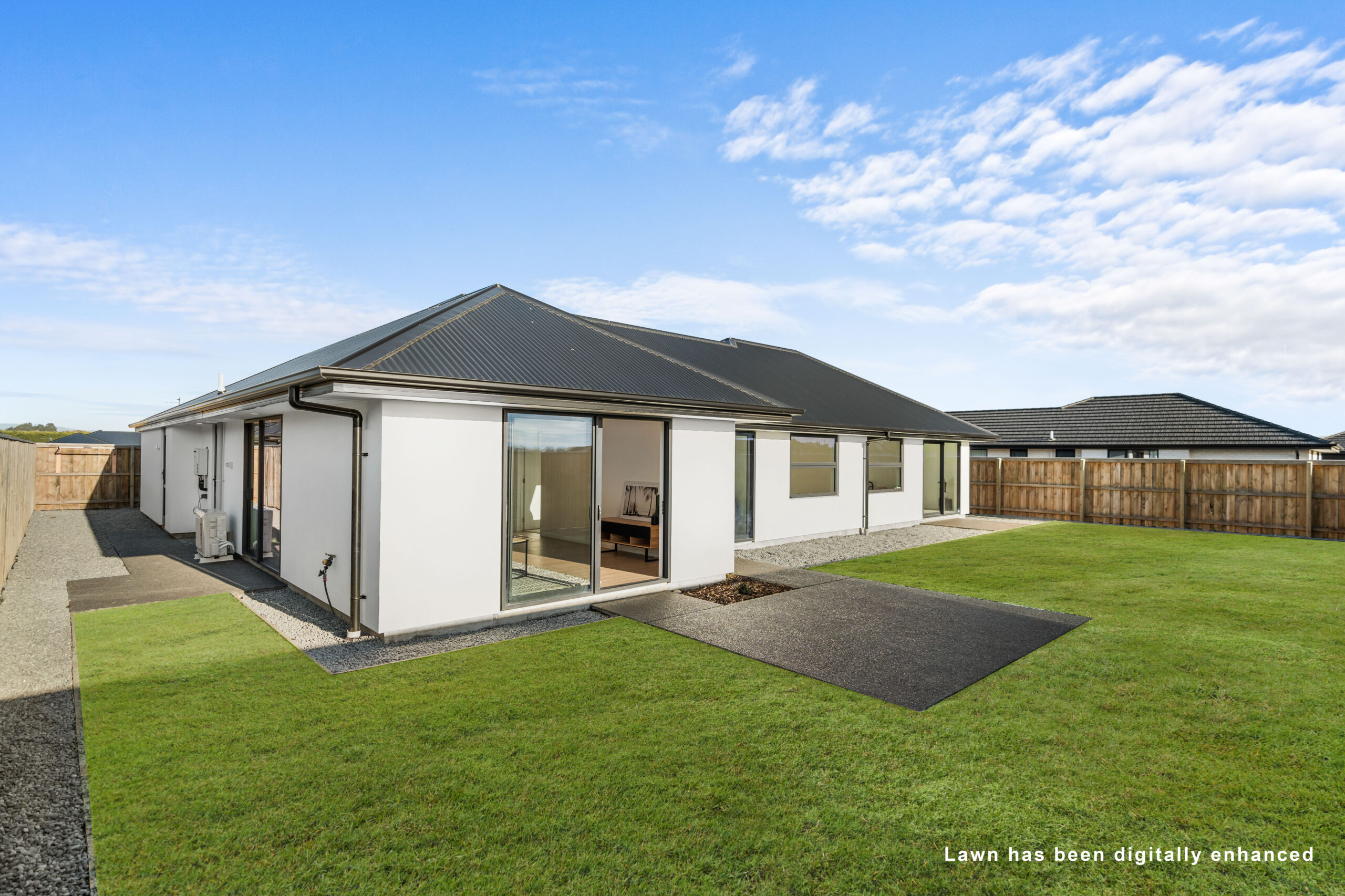
Our current Prebbleton examples make that gap tangible. As of April 2026, we have a 3-bedroom home at Lot 39 Trices Road priced from $849,000, with a 149.93m² floor area on a 301m² section. We also have a 4-bedroom home with study at Lot 85 Hamptons Grove priced from $899,000, with a 176m² floor area on a 353m² section. That is a very different buying proposition from a low-$600,000s townhouse.
For buyers who want space but still want cost certainty, turnkey or fixed-price packages can make sense. At Tailored Homes, that is one reason we structure our projects around clear inclusions and a 10-year Master Build Guarantee. First-home buyers do not need extra uncertainty.
Step 4: Let suburb choice follow your budget, commute, and stage of life.
Christchurch is not one market, so the suburb that suits you best depends on both your budget and the kind of daily life you want.
If your budget is in the low-to-mid $600,000s
This is usually townhouse territory rather than standalone family-home territory. In southwest Christchurch, Wigram stands out because it combines a newer housing stock with established amenities, employment access, and genuine owner-occupier appeal. If you work near the airport, Hornby, or the CBD fringe, Wigram is an easy suburb to keep on your shortlist.
At that budget level, you should be comparing trade-offs carefully: do you want a newer, lower-maintenance home with less land, or an older property in a different suburb that may need more work?
If your budget is around the city median and above
Once you move toward the Christchurch median price, your choices widen. Existing homes in established suburbs become more realistic, and some family-oriented locations within Christchurch city limits start to open up. Halswell often sits in this middle ground for buyers who want to stay in Christchurch but still prioritise schools, parks, and family practicality.
If you are comparing the southwest corridor, read our Wigram vs Prebbleton vs Halswell suburb guide. It is written for Canterbury conditions rather than a generic national audience.
If you want more space and can stretch toward the high $800,000s
That is where Selwyn locations such as Prebbleton become much more relevant. Prebbleton is about 15 minutes from Christchurch CBD, but it feels more village-like than inner-city suburbs. It is one of the reasons families continue to look there for newer standalone homes. As local new home builders in Prebbleton, we publish current 3 and 4-bedroom homes there.
Our team sees this pattern often: buyers start by looking at older homes closer in, then realise that if their budget can move higher, Prebbleton can deliver a brand-new 3 or 4-bedroom home with better long-term certainty. The right answer depends on your commute, your family plans, and how much maintenance risk you are comfortable taking on.
Step 5: Get finance-ready before you make offers.
The buyers who move fastest in Christchurch usually do their paperwork before they start emotionally committing to homes.
For new builds, remember that all building work must comply with the New Zealand Building Code, and Christchurch City Council handles building consents and code compliance certificates locally. On a turnkey purchase, the developer normally manages that process, but you should still understand what documentation you will receive at settlement.
- Get lender or broker feedback before you shop seriously.
- Confirm your KiwiSaver position and application timing.
- Choose your solicitor early, especially if you are considering a new build contract.
- Ask exactly what is included in the fixed price, and what is not.
- For existing homes, line up a builder’s report and property-file review quickly.
If you want to compare low-deposit pathways, KiwiSaver use, and Christchurch-friendly new-build options in one place, start with our first-home finance guide and then browse our current new builds for sale.
Mistakes that slow Christchurch first-home buyers down.
The biggest delays usually come from avoidable preparation gaps rather than from the market itself.
- Saving toward the wrong deposit target. A buyer who assumes 20% is the only route may spend another year renting when a 5% or 10% pathway could already be realistic.
- Starting with suburbs instead of finance. Falling in love with a postcode before you know your lending limit wastes time and creates disappointment.
- Leaving KiwiSaver too late. Providers, solicitors, and lenders all need lead time.
- Comparing price, not total ownership cost. A cheaper older house can become more expensive once repairs, heating, insulation, and maintenance are factored in.
- Treating every new build as equal. Title type, fixed-price certainty, inclusions, completion timing, and builder track record all matter.
- Skipping Christchurch-specific due diligence on older homes. Consent history, quake repairs, drainage, and moisture checks are not optional here.
We see first-home buyers make the best decisions when they stay disciplined: know the numbers, know the contract, and know what trade-off you are making between price, location, and certainty.
Christchurch first-home buyer FAQ
These are the questions we hear most often from local first-home buyers.
How much deposit do I need to buy my first home in Christchurch?
There is no single answer. A 20% deposit is still common, but some buyers use a 5% or 10% pathway through a Kāinga Ora First Home Loan or a lender willing to back a qualifying new build. As a simple example, 5% of $650,000 is $32,500.
Can I use KiwiSaver for a first-home deposit?
Usually yes, if you have been a KiwiSaver member for at least 3 years and meet the first-home withdrawal rules. Most of your balance can be used, but $1,000 must stay in the account, and the home must be for you to live in.
Are new builds easier to buy with a low deposit?
They can be. The RBNZ LVR rules exempt construction loans and newly built homes bought from a developer within six months of completion, which can give lenders more flexibility. You still need to meet servicing, credit, and lender policy requirements.
Is Wigram or Prebbleton better for first-home buyers?
Wigram is often the stronger fit if you want a lower-entry townhouse and easier maintenance. Prebbleton is usually better for buyers who want a larger standalone home and can budget materially higher.
What should I check on an older Christchurch home?
Start with a builder’s report, then review consent history, insurance history, any earthquake repairs, drainage and moisture risks, and whether previous work has code compliance sign-off. In Christchurch, those checks are part of the basics, not an optional extra.
If you want a first-home plan built around real Christchurch options rather than a national template, talk to Tailored Homes. We can show you first-home friendly new-build options in Christchurch, explain what to prepare before you buy, and help you compare whether a townhouse, standalone new build, or another pathway fits your budget best.