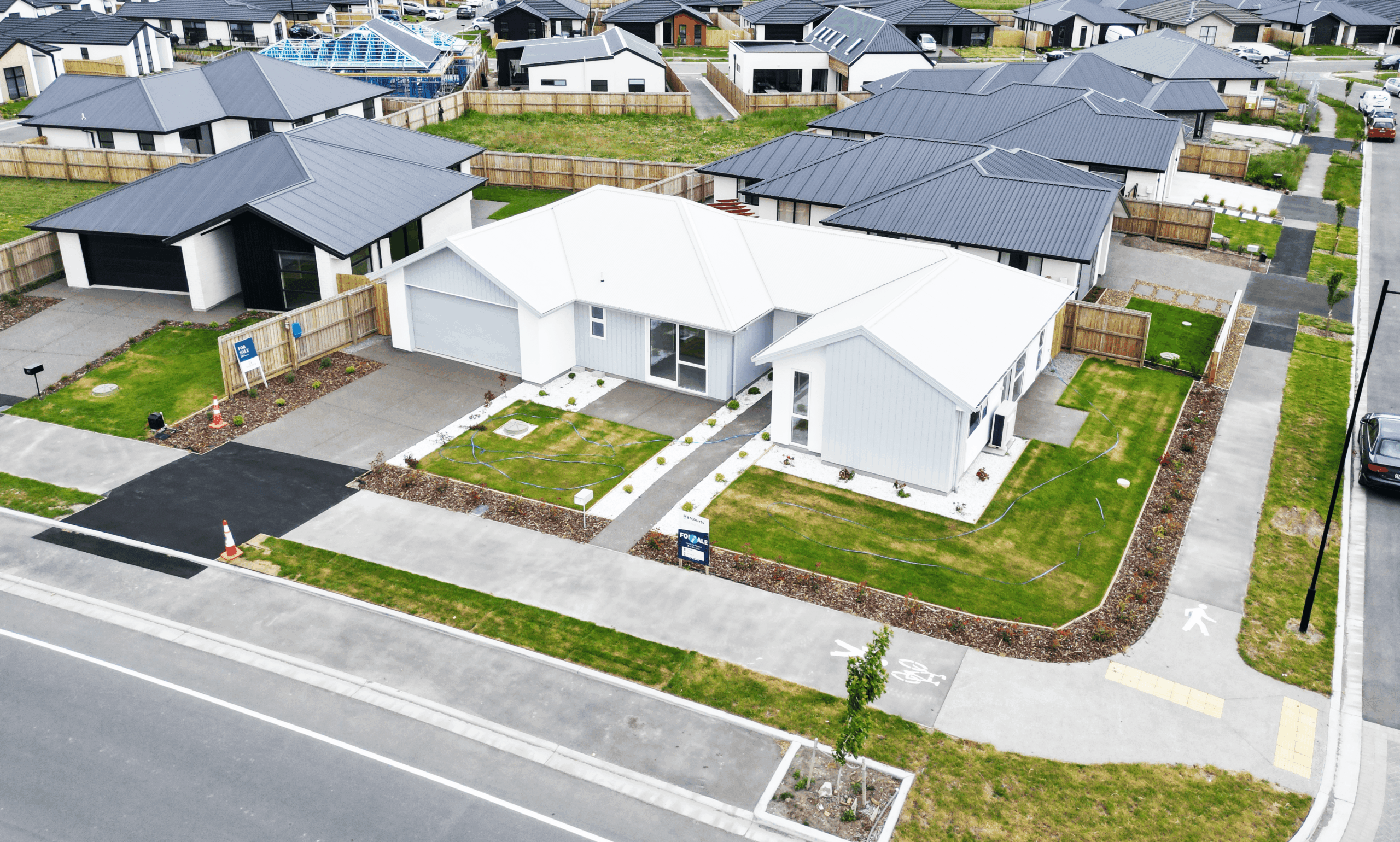
Christchurch is one of the few New Zealand markets where this comparison is genuinely close in 2026. We are not a media outlet or a mortgage broker; we are a Canterbury builder with 16 years in the market and 100+ homes delivered, so we see both the spreadsheet case and the post-settlement reality. For the wider market backdrop, start with our Christchurch property investment guide.
As of 8 April 2026, the Reserve Bank of New Zealand’s official cash rate is 2.25%, and Christchurch has just entered the Te Kaha era after the stadium opened on 27 March 2026. Easier credit and stronger city fundamentals help, but they do not erase the core decision: buy day-one yield, or buy lower friction.
The headline trade-off
In 2026, existing rentals usually win on day-one yield, while new builds usually win on deposit efficiency, compliance and maintenance.
The important change is tax: since 1 April 2025 the interest-deductibility gap has largely disappeared, so the better framing is not tax breaks versus no tax breaks, but upfront yield versus operating drag. In Christchurch, that gap can be surprisingly narrow when the new build is well bought, and neither path guarantees outperformance.
Yield comparison: $700k new build vs $620k Hornby existing
Gross yield still slightly favours the cheaper existing asset, but net yield often flips once you price maintenance honestly.
Worked example
We will use a conservative model: a $700,000 Christchurch new build renting at $680 a week, versus a $620,000 existing 3-bedroom Hornby house renting at $620 a week. That $680 assumption is not aggressive; in Wigram, our Four Seasons Estate 3-bedroom appraisals are currently $680 to $710 a week on prices from $659,000.
New build gross yield: $680 x 52 = $35,360. $35,360 / $700,000 = 5.05%.
Existing gross yield: $620 x 52 = $32,240. $32,240 / $620,000 = 5.20%.
Now strip out real operating costs. Using a 9% management allowance, Christchurch City Council rates of about $3,630 on a $700,000 property and about $3,260 on a $620,000 property, insurance allowances of $2,000 versus $2,300, and maintenance budgets of $1,000 versus $4,500, the new build lands around 3.6% net before interest and tax, while the older Hornby house is closer to 3.1%.
That is the real investor lesson. Gross yield makes older stock look cleaner than it is. At $710 a week, the same $700,000 new build rises to 5.27% gross, which is why project selection matters more than the generic label. If you want to compare live stock rather than a theoretical example, browse our current new homes for sale in Christchurch before you model yield. If you want a calculator version, use our Rental Yield Calculator article.
LVR and finance differences as of 2026
Finance still materially favours qualifying new builds in 2026, even after the Reserve Bank eased investor LVRs in December 2025.
Under the Reserve Bank of New Zealand’s LVR rules, banks can now have up to 10% of new investor lending above 70% LVR. For a standard existing investment, that still means 30% deposit is the default maths.
Existing $620,000 purchase: 30% deposit = $186,000. Borrowing = $434,000.
New build $700,000 purchase: qualifying construction loans and newly built homes bought from the developer within 6 months of completion remain exempt from the LVR speed limit. A 20% deposit is $140,000, so the capital gap versus the existing example is $46,000.
The same pattern carries into DTI policy. The RBNZ’s DTI framework exempts qualifying construction loans and purchases of newly built homes from the developer within 6 months of completion, which keeps the new-build lane cleaner for leveraged investors. RBNZ’s C30 data released on 25 March 2026 also showed NZ$931 million of exempt investor lending in February 2026 across all exemption categories, so this is not theoretical.
Bank policy still matters. Exempt does not mean automatic. But if deposit size is your main constraint, the new-build route remains structurally easier. Our new-build exemption guide and bank pre-approval guide go deeper on lender process. If you are offshore, also verify purchase eligibility and lender appetite before you model any deposit scenario.
Tax treatment after the 2024-2026 rule changes
The tax advantage of new builds is much smaller in 2026 than many investors still think.
Under Inland Revenue’s interest limitation rules, 100% of interest on residential investment property became deductible again from 1 April 2025. In plain English: by the 2026 tax year, interest deductibility is no longer a special perk of new builds.
The same levelling has happened on sale rules. For properties sold on or after 1 July 2024, Inland Revenue’s bright-line test moved to a 2-year period, so the old new-build versus existing split is gone.
Where new builds can still hold a modest edge is chattels. Inland Revenue’s DEP80 chattels guidance still allows depreciation on qualifying residential rental chattels such as blinds, carpets, appliances and some heating or ventilation assets. The building itself is not the prize; the value sits in the qualifying chattels schedule. A turnkey new build usually has a cleaner, newer and easier-to-document allocation. Existing homes can also claim chattels depreciation, but the allocations are usually smaller and messier.
So do not buy a new build in 2026 for an outdated tax myth. Buy it because the asset is easier to finance, easier to hold, and cleaner from day one.
Healthy Homes compliance
Healthy Homes is where many existing-rental spreadsheets understate capex.
Tenancy Services requires all private rentals to comply with the Healthy Homes standards from 1 July 2025. The standards cover heating, insulation, ventilation, moisture ingress and drainage, and draught stopping, and landlords who miss the mark can face penalties of up to $7,200.
A genuine new build is normally compliant on handover. An older Christchurch rental may still need a correctly sized heat pump, extractor fans, insulation top-ups, a ground moisture barrier, gutter or drainage work, and draught sealing. That is why a $5,000 to $15,000 retrofit budget is common before you even talk about cosmetic renovation.
Maintenance and capital cost over the first 10 years
The first 10 years are usually where a new build quietly wins back its lower headline yield.
For a brand-new rental, about $1,000 a year is a reasonable maintenance model for small fixes, servicing, and minor tenancy wear. For a 30-year-old house, $3,000 to $6,000 a year is more realistic once you account for hot water cylinders, roofing, plumbing, paint cycles, appliances and the occasional unpleasant surprise.
Christchurch property managers commonly tell owners to stop pretending older stock is low-maintenance. Even Metro Property Management’s conservative rule of thumb is at least 0.3% to 0.5% of property value each year, which already implies roughly $1,860 to $3,100 on a $620,000 property before bigger age-related jobs.
That is one reason our investors keep coming back to our Four Seasons Estate Wigram investor guide: lower repairs means lower stress, not just lower invoices.
Tenant pool and rent ceiling
New builds usually achieve higher rent per square metre and attract a more stable tenant pool, but existing homes can be easier to re-let when budgets tighten.
In southwest Christchurch, the rent premium is real. Our Wigram appraisals put 3-bedroom townhouses at $680 to $710 a week and 2-bedroom units around $600, while current 3-bedroom Hornby listings are sitting around $620 a week. That is roughly a 10% to 15% premium for the right new-build product.
Tenants pay for warmth, lower power bills, modern kitchens, better bathrooms, parking and the confidence that the home is not one maintenance call away from disruption. The trade-off is that older stock has more price-flex in a soft market, because the absolute weekly rent is lower.
Capital growth: land still matters
If your thesis is land-led capital growth, detached existing houses still have the cleaner long-run argument; if your thesis is growth-corridor new stock, the gap narrows.
CoreLogic has estimated that new builds typically sell at about a 6% premium to existing properties nationally. Its 2025 suburb-level work also showed standalone houses recovering more consistently than townhouses and flats. Our reading of that data is simple: land content still matters.
That does not mean every existing house wins. It means the worst new-build purchase is an oversupplied, investor-only product in a flat location. The better new-build purchase is a disciplined buy in a genuine growth corridor with owner-occupier demand.
In Canterbury, that is why we separate Wigram cash-flow stock from Selwyn family-growth stock. Prebbleton, Lincoln and Rolleston are different from inner-city investor clusters because resale depth is broader. For suburb context, read our Christchurch suburb comparison.
So the honest answer is this: existing-with-land probably still has the edge on pure long-run capital growth, but a well-priced new build in Wigram or Selwyn can narrow that gap while being much easier to hold.
Decision matrix
If you score the two strategies across the variables that actually affect investor stress, new build wins most operational categories and existing wins the pure yield category.
- Upfront gross yield: existing wins.
- Deposit efficiency: new build wins.
- Tax simplicity in 2026: slight new-build edge.
- Maintenance risk: new build wins.
- Healthy Homes risk: new build wins.
- Tenant quality and rent premium: new build wins.
- Vacancy resilience in a soft market: existing wins.
- Land-led capital growth: existing wins.
- Exit liquidity: draw, but location matters more than age.
- Cash flow after real expenses: new build often wins.
For most leveraged investors in 2026, new build is the cleaner play. Existing still makes sense if you have more equity, can absorb compliance and repair capex, and are deliberately buying land-led upside.
FAQ
These are the five questions we get most often from Christchurch investors comparing new and existing stock.
Is a new build a better investment than existing in 2026?
Usually yes if you are leveraged, deposit-constrained, or want lower maintenance and compliance risk. Existing can still win if your priority is maximum day-one yield from a cheaper purchase or stronger land exposure.
Can I deduct interest on a new-build investment?
Yes, but that is no longer unique to new builds. Inland Revenue restored 100% interest deductibility for residential investment property from 1 April 2025, subject to the normal deductibility and ring-fencing rules.
Does the LVR new-build exemption apply to investors?
Yes. Under current RBNZ settings, qualifying construction loans and newly built homes bought from the developer within 6 months of completion remain exempt from the LVR speed limit, although each bank still applies its own credit policy.
What is the cheapest new-build investment opportunity in Christchurch?
As of April 2026, our most accessible active investor-grade stock is Four Seasons Estate Wigram from $617,000, but pricing and availability change. Browse current new-build homes in Christchurch before assuming any price point is still available.
How long do I need to hold a new build to outperform existing?
There is no fixed hold period. A new build can outperform from day one on deposit efficiency, compliance and maintenance, while an existing house may need a longer 7-10 year view to justify the extra friction through land-led growth.
If you want an investor-grade option rather than a theoretical spreadsheet, explore our new-build homes for sale in Christchurch and ask our team to walk you through Wigram, Prebbleton and Lincoln numbers. We build in Canterbury, and we will tell you where the maths is strong and where it is not.