Townhouse vs custom build: the short answer
One-line summary: In the townhouse vs custom build Christchurch decision, a townhouse is usually faster and cheaper upfront, while a custom build is slower and costlier but shaped around your land, layout, and lifestyle.
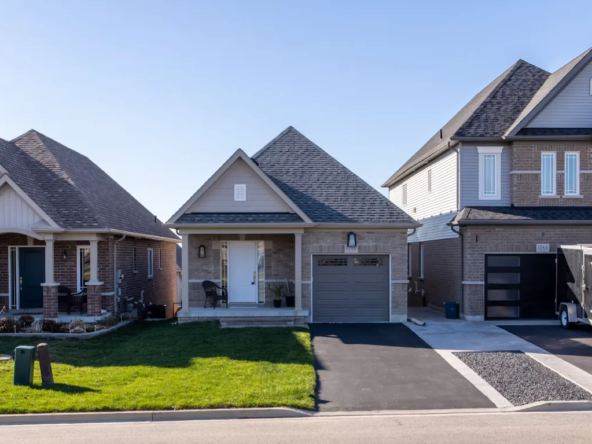
At Tailored Homes, we build both freehold townhouses and stand-alone homes across Canterbury, so this is a comparison we make with buyers every week. We see first-home buyers choose Wigram townhouses for certainty, while families in Prebbleton, Lincoln, and Halswell choose custom or stand-alone builds because they want a second living space, a bigger section, or a layout tuned to sun and privacy. In 2026, with the Reserve Bank of New Zealand (RBNZ) holding the Official Cash Rate at 2.25% on 8 April 2026, finance conditions are easier than they were at peak rates, but the better housing model still comes down to fit. If you already know the direction you want to explore, compare our current Christchurch townhouses for sale and our custom home builders in Christchurch guide, then use our Christchurch new-build homes hub to compare both paths side by side.
Speed and timeline
Summary: A ready or near-ready townhouse can get you into a new home far sooner; a custom build gives you more control, but time is part of the price.
For a completed or near-complete turnkey townhouse, a realistic timeframe is often 0-3 months from accepted offer to settlement. A custom build is usually more like 9-14 months from design start for a straightforward Christchurch project, and longer if land title, siteworks, or resource consent slow things down. That gap exists because a townhouse buyer is stepping into a product that has mostly been designed, costed, consented, and scheduled already. The custom timeline also includes concept design, pricing rounds, engineering, selections, and council questions before the physical build even feels real.
Why does that matter? Because the real cost of waiting is not just patience. It can mean extra rent, storage, bridging finance, rate-lock stress, or carrying your current home longer than planned. If you need to align a move with a school term, a tenancy ending, or a change in family size, speed can outweigh the appeal of perfect design. The one caveat is off-plan townhouses: always use the developer’s stated completion date, not the generic 0-3 month rule.
Price comparison in Christchurch (as of April 2026)
Summary: Townhouses normally win on total entry price, but custom homes often give you more space and land for each dollar spent.
As of April 2026, a typical Christchurch 3-bedroom townhouse is often landing around $620,000-$720,000, while a custom or design-and-build home with land is more commonly $750,000-$1.1 million depending on suburb, section, size, and finish level. Not every custom build sits at the top of that range; compact house-and-land or design-build packages can narrow the gap, but the step up from townhouse pricing is still real. That means the deposit gap is material: 5% of $650,000 is $32,500, while 5% of $900,000 is $45,000 before legal fees, moving costs, and any contingency.
The part many buyers miss is cost per square metre. A smaller townhouse can be cheaper overall but not necessarily cheaper space. Tailored Homes’ live Four Seasons Estate Wigram stock starts from $617,000 for about 74m2, which is roughly $8,300 per square metre. By comparison, LOT 93 Earlsbrook in Lincoln is listed at $759,000 for 144.55m2, or about $5,250 per square metre, and LOT 49 Hamptons in Prebbleton is $1,039,900 for 191.65m2, or about $5,400 per square metre. In other words, townhouse affordability is mostly about lower total spend and a smaller deposit, not automatically cheaper space.
If you want to benchmark live medium-density pricing, you can compare current stock through our Christchurch townhouses range.
Hidden cost differences to watch
- Townhouse buyers should check what is actually included: appliances, blinds, landscaping, parking, storage, settlement timing, and any shared access or maintenance obligations.
- Custom buyers should allow for survey, geotechnical work, engineering, drainage, retaining, driveways, fences, landscaping, spec upgrades, and finance holding costs during the build.
Design freedom and lifestyle fit
Summary: A townhouse asks you to fit your life into a proven plan; a custom build lets the plan fit your life.
With a townhouse, the structure is usually set. You may be able to choose paint colours, flooring, splashbacks, some appliances, or minor fixture upgrades, but the core layout, orientation, stair position, outdoor area, and parking setup are normally fixed. That is not a flaw. For many buyers, it is the point. Fewer decisions can mean fewer mistakes, fewer delays, and a more predictable budget.
Custom is different. You can shape the floor plan, window placement, materials, storage, ceiling heights, heating approach, and how the home sits on the section. That matters in Christchurch because sun, privacy, drainage, access, and shelter can change how a house feels day to day. The Ministry of Business, Innovation and Employment (MBIE) notes that New Zealand’s Building Code is performance-based, which gives designers room to solve the brief in different ways rather than forcing one standard plan.
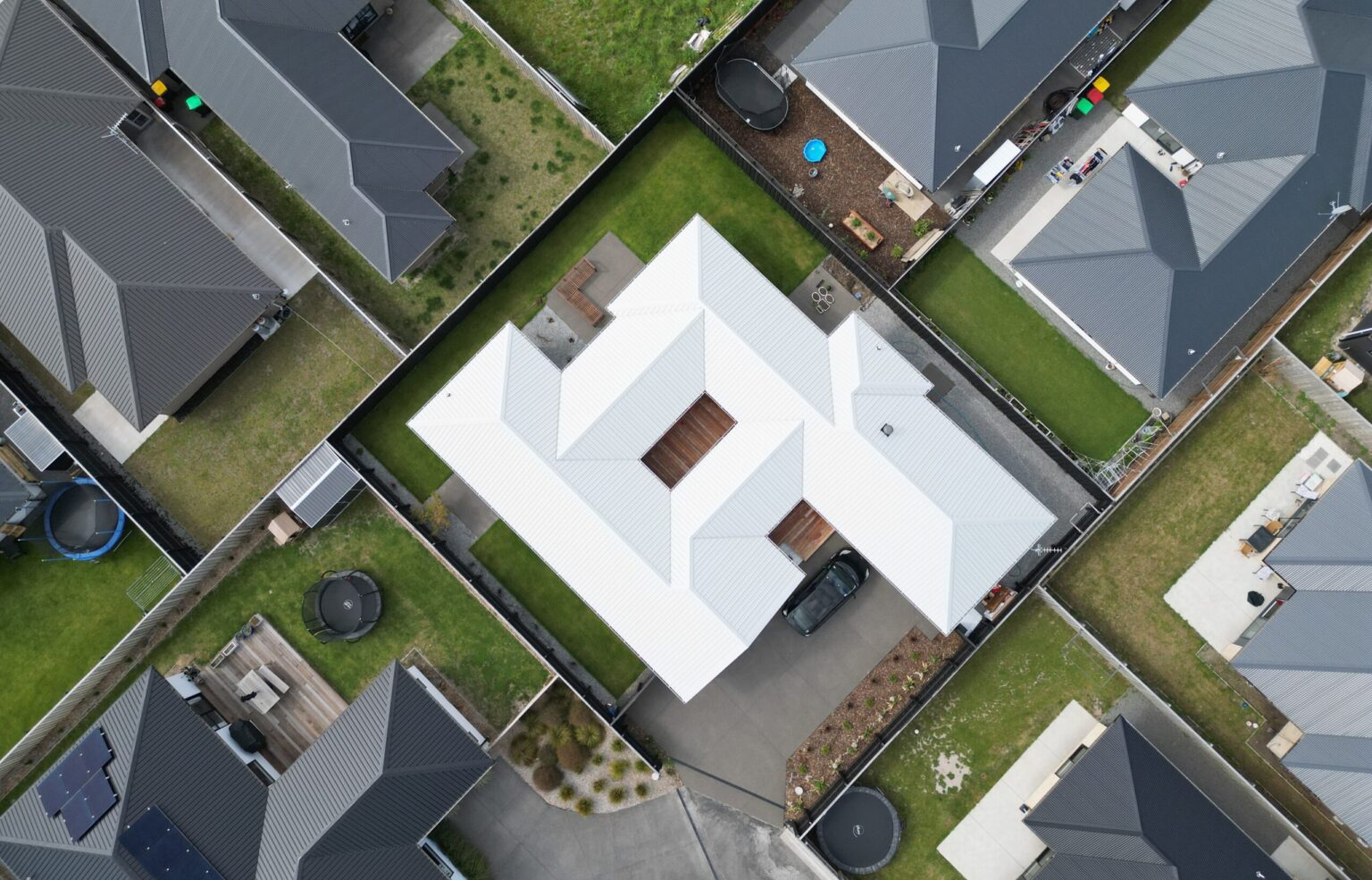
You can see that difference in our Halswell Internal Garden Showcase at 3 Ferbane Way. That home was designed at 210m2 with four bedrooms, a separate lounge, a butterfly pitch roof, and a 10m2 internal courtyard because the brief needed light, privacy, and a stronger architectural feel. That is the kind of site-specific decision you usually only get through a genuine design-and-build path. If that is the route you are considering, read through our custom home builders in Christchurch guide before comparing builders.
Resale and capital growth
Summary: A well-located townhouse can resell well, but a custom freehold home usually has the stronger long-term land story.
CoreLogic NZ reported in 2025 that 62% of suburbs had flat or rising standalone house values, versus 54% for townhouses and flats, and 22% of house suburbs rose at least 2% compared with 16% of townhouse suburbs. That is not a guarantee that every house outperforms every townhouse, but it does show detached homes have tended to recover more consistently.
The land point matters too. CoreLogic’s hedonic index treats land area as an important value attribute, so our inference from that methodology and the property-type data is that a larger freehold land component usually gives you a better long-run resale story. That said, Christchurch already has a high townhouse share, nearly 24% of stock according to CoreLogic, so townhouses are not a fringe product here. A good freehold townhouse in a proven suburb can still be a sensible buy. If pure capital growth is the priority, though, land still tends to tilt the argument toward custom or stand-alone homes.
For Christchurch buyers, that usually means a detached home on a functional section gives you more ways to create value later, whether through family appeal, outdoor living, or future flexibility. A townhouse can still perform strongly where entry price, low upkeep, and location matter most, but its resale story usually relies more heavily on suburb quality, layout efficiency, and specification than on land scarcity alone.
Council, consents, and warranty
Summary: Townhouse buying is usually lighter on paperwork for the buyer, but both models still sit under the same legal and quality framework.
MBIE states that all building work in New Zealand must comply with the Building Code, and Christchurch City Council manages building consents and inspections locally. A resource consent is separate, and may also be needed if a proposal does not meet District Plan rules around matters such as setbacks, site coverage, height, or subdivision.
In a townhouse purchase, the developer usually runs the design, consent, inspections, and Code Compliance Certificate process before you settle. In a custom build, your builder or design team usually coordinates the PIM, consent documents, consultants, inspections, and final sign-off on your behalf. That responsibility should be explicit in the contract. MBIE also notes that if a $30,000-plus residential building contract does not say who gets the approvals, that obligation defaults to the building contractor.
Warranty protection is layered. MBIE’s implied warranties apply for up to 10 years to residential building work, and also cover the sale of household units by a commercial on-seller. On top of that, Registered Master Builders can offer a 10-Year Guarantee for standalone homes and a Multi-Unit 10-Year Guarantee for development purchases. Tailored Homes is a Master Builders member and states that its homes come with a 10-year Master Build Guarantee.
In practical terms, ask before signing who is supplying the plans, lodging the consent, answering council requests for information, booking inspections, and handing over the final Code Compliance Certificate and guarantee documents. That checklist matters more in a custom build because delays often start in approvals and documentation before they show up on site.
Decision matrix
Summary: If you score both options against the things that actually matter to you, the better path usually becomes obvious.
| Factor | Townhouse | Custom Build |
|---|---|---|
| Upfront price | 5/5 | 2/5 |
| Speed | 5/5 | 2/5 |
| Customisation | 2/5 | 5/5 |
| Resale upside | 3/5 | 5/5 |
| Section size | 1/5 | 5/5 |
| Build and approval risk | 4/5 | 2/5 |
| Decision stress | 4/5 | 2/5 |
| Lifestyle fit over 10+ years | 3/5 | 5/5 |
Here, 5/5 means the option is generally stronger on that factor for most Christchurch buyers, not that it is universally better for every brief.
A useful way to use this table is to circle your top three factors and score them with your partner, broker, or lender first. Many buyers think they are choosing between price and design, then realise deposit size, timing, or future space needs are actually the factors driving the decision.
Real Tailored Homes examples
Summary: The fastest way to make this comparison practical is to look at a real townhouse and a real custom-style project side by side.
For a live townhouse example, look at Four Seasons Estate Wigram at 41 Deal Street. It is a boutique freehold townhouse development in Wigram with 1-3 bedroom options, roughly 73.9m2-117.7m2 floor areas, and pricing from $617,000 as of April 2026. That is the townhouse case in one line: lower entry price, lower maintenance, simpler buying path.
For a design-led custom example, look at our Halswell Internal Garden Showcase. The 210m2 layout, separate lounge, internal courtyard, and butterfly roof show what changes when the brief starts with the family and the site instead of a fixed developer plan. Neither model is better in the abstract. They solve different problems.
Set beside Tailored Homes’ Lincoln and Prebbleton stand-alone stock, the trade-off becomes more concrete: roughly $617,000-$624,000 can buy a 74-75m2 townhouse in Wigram, while roughly $759,000-$1,039,900 buys 144.55-191.65m2 and a much larger land component in Lincoln or Prebbleton. That is why serious buyers compare deposit, floor area, section size, and move-in timing together rather than headline price alone.
FAQ
Is a townhouse a good first home?
Yes, often. A townhouse can be a strong first home if your priorities are price, low maintenance, and getting into a newer home sooner. The trade-off is usually less land, less storage, and less flexibility to change the layout later.
Does a custom build hold value better?
Often, but not automatically. Detached freehold homes usually have a stronger land component and CoreLogic’s recent data shows houses recovering more consistently than townhouses and flats. But location, school zones, overcapitalising, and build quality still matter just as much as property type.
Can I get a custom build with 5% deposit?
Sometimes. The RBNZ exempts construction loans and newly built homes bought from a developer within six months of completion from its LVR restrictions, but banks still apply their own serviceability and credit rules. In practice, 5% is possible for some buyers, but it is harder at higher price points.
How long does a Christchurch custom build take?
For a straightforward project, allow around 9-14 months from design start. If the land title is not yet issued, the section is complex, or a resource consent is required, the timeline can run longer.
What is the cheapest way to get into a new home in 2026?
Usually a smaller turnkey or near-complete townhouse. Using current Tailored Homes stock as an example, 5% of $617,000 is $30,850, which is materially lower than 5% of $900,000 at $45,000. If lowest total spend is the main goal, townhouse usually wins.
If you want an honest side-by-side comparison based on real Christchurch stock, browse the live options on Tailored Homes, then ask us to price the gap between a ready-made home, a house-and-land package, and a fully custom brief.